AC Not Cooling? 10 Reasons Your AC Runs but Won't Blow Cold Air

Written by Ergys Hisa
Owner of E&E Gliddon Home Services and a former lead HVAC technician with more than a decade in the field before ownership.
An AC that is not cooling has lost one of the three things cooling requires: airflow across the coils, the correct refrigerant charge, or the electrical capacity to run its motors. The symptom wears different names in different homes: the AC is running but not cooling, the vents blow air but not cold air, or the system simply is not keeping up on a hot afternoon. Every version traces back to the same ten causes. This guide covers each one in the order technicians find them most often.
"Why isn't my AC cooling?" is the first question our office hears on summer afternoons. Knowing which cause fits your symptoms helps you resolve the simple ones yourself. It also keeps a small failure from becoming a compressor-sized one. Three of the ten causes have safe self-checks that fix the problem without a service call. The rest need instruments, and for those, professional AC Repair in St. Petersburg, FL is the next step. The final questions cover when to shut the system off, how to reset it correctly, and what a sudden cooling loss means compared to a gradual one.
Why Is Your AC Running but Not Cooling?
An AC runs without cooling because of one of the following 10 causes, ordered from most to least common:
- Dirty air filter
- Thermostat settings
- No power to the outdoor unit
- Dirty condenser coils
- Frozen evaporator coil
- Refrigerant leak
- Failing capacitor or fan motor
- Leaking attic ductwork
- Wrong-sized or aging system
- Extreme heat load
The first three cost little or nothing to fix and take minutes to check. The middle four are component failures that need a technician. The last three are system-level problems that explain an AC that blows air but not cold, year after year, no matter how many parts get replaced.
Dirty Air Filter
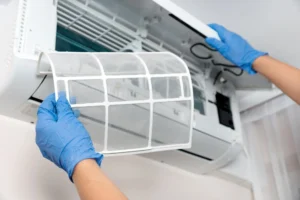
A dirty air filter is the most common reason an AC stops cooling. The blower cannot pull enough air through a clogged filter, so less air crosses the cold evaporator coil. The little air that reaches your vents feels weak and barely cool. Left long enough, the starved coil freezes, and cooling stops entirely.
Check yourself first:
pull the filter and hold it to a light. Replace it and give the system an hour if light does not pass through. Replacing a dirty filter can cut an air conditioner's energy use by 5 to 15 percent, according to the U.S. Department of Energy. Filter frequency and ratings have their own trade-offs, covered in the AC Air Filter Guide: How Often to Change It and Which MERV to Use. A MERV rating measures how finely a filter captures particles. A rating too high for your blower chokes airflow the same way dirt does.
Thermostat Settings
Thermostat settings stop more cooling than most homeowners expect, and they cost nothing to fix. A thermostat set to ON instead of AUTO runs the fan continuously, so the vents blow room-temperature air between cooling cycles. The result feels exactly like an AC not blowing cold air. A mode switched to heat or fan, dead batteries, or a schedule override produce the same call.
Check yourself first:
set the mode to cool, the fan to AUTO, and the target five degrees below room temperature, then wait ten minutes. The problem is not the thermostat if the compressor never starts outside.
No Power to the Outdoor Unit
An outdoor unit without power leaves the indoor blower running alone, which moves air without cooling it. The usual cause is a tripped breaker, a pulled outdoor disconnect, or a float switch that shut the system down over a full drain pan.
Check yourself first:
look at the breaker panel and reset a tripped AC breaker one time only. Repeated resets risk damaging the compressor and the wiring, so one reset is the limit. A breaker that trips again is reporting an electrical fault. The causes sit on both sides of our two licenses: AC Keeps Tripping the Breaker: 8 Electrical Causes and Fixes.
Dirty Condenser Coils
Dirty condenser coils trap the heat your system is trying to release outside. The refrigerant arrives at the outdoor coil carrying your home's heat. A coil coated in dirt, grass clippings, or corrosion cannot shed it. The system runs longer, cools less, and wears faster.
In beach communities from St. Pete Beach to Tierra Verde, salt air corrodes condenser coils years ahead of schedule. Our technicians usually find the corrosion before the owner has noticed anything except a weaker AC. Coil condition is a maintenance item. The process, cost, and coastal protection options are covered in AC Coil Cleaning: Process, Cost, and Salt Air in Coastal Florida.
Frozen Evaporator Coil
A frozen evaporator coil blocks the airflow it needs to thaw itself. The freeze feeds itself until the vents barely blow at all. Ice forms when airflow drops or refrigerant pressure falls. The first sign is usually weak, mildly cool air followed by none.
Check yourself first:
open the air handler access and look for ice on the coil or the refrigerant lines. If you see ice, turn cooling off and run the fan only until the ice melts. Never chip at it. The freeze always has an upstream cause, and finding it is the point of Frozen AC Unit: Why Your AC Freezes Up and How to Thaw It Safely.
Refrigerant Leak
A refrigerant leak removes the substance that carries heat out of your home, so the system blows air but not cold. Refrigerant does not get used up, which means low refrigerant always means a leak. The signs: cooling that fades over days or weeks, ice on the lines, hissing near the coils, and a system that runs but never reaches the set temperature.
A recharge without a leak repair buys weeks and wastes the refrigerant. That is why we treat every low-charge reading as a leak search. Costs, search methods, and the reason annual top-offs never end well are covered in AC Refrigerant Leak: Signs, Repair Cost, and Why Recharges Aren't a Fix.
Failing Capacitor or Fan Motor
A failing capacitor or fan motor stops the outdoor unit from shedding heat, even while the indoor blower keeps running. The compressor may run without its fan, overheat, and shut down. The result is cooling that comes and goes before it quits.
Listen at the outdoor unit: a hum without a spinning fan points to the capacitor or the motor. Florida summer heat kills capacitors more than any other electrical part we replace. Telling the two failures apart takes a meter. Both paths are covered in AC Fan Not Spinning: Capacitor, Motor, and Other Causes.
Leaking Attic Ductwork
Leaking ductwork cools your attic instead of your rooms. Florida attics reach 130 degrees in summer. Deteriorated duct runs up there are one of the patterns our technicians see over and over in Pinellas homes. The system produces cold air, the ducts lose a share of it, and the rooms farthest from the air handler stay warm.
The signs:
uneven cooling between rooms, vents that blow weakly at the far end of the house, and bills that climb while comfort falls. Duct leakage is measurable, and sealing or replacing the failed runs restores capacity the system already had.
Wrong-Sized or Aging System
A wrong-sized or aging system is not keeping up rather than failing outright. An undersized system runs constantly on hot days and never reaches the set temperature. An oversized one cools the air quickly but shuts off before removing humidity. The house feels clammy at the right temperature. An aging system loses capacity gradually as compression weakens and coils foul internally.
Rule out the first seven causes for an AC that blows cold but has stopped keeping up. Sizing and age are what remain. That diagnosis deserves measurements rather than guesses: a load calculation for sizing, and a capacity check against the system's age.
Extreme Heat Load
Extreme heat load makes a healthy AC look broken. On a 95-degree August afternoon, a correctly sized Florida system may run nearly continuously and hold the house two to three degrees above its usual mark, then catch up in the evening. That pattern is heat load, not failure.
The line between normal and fault: a healthy system still moves cold air and recovers after sunset, while a faulty one runs all night without gaining ground. What normal runtime looks like by season is covered in Is It Normal for an AC to Run All Day in Florida? Runtime Explained.
What to Check Before You Call for AC Repair
Four checks separate the free fixes from the real repairs. Run them in order:
- Replace the filter if light will not pass through it.
- Set the thermostat to cool, AUTO, and five degrees below room temperature, then wait ten minutes.
- Reset a tripped breaker one time only.
- Look for ice on the coil and lines, and thaw with fan-only mode if you find it.
Cooling that returns confirms the cause. The remaining causes need gauges and meters when the system still runs without cooling after all four. Continuing to run the system risks the compressor. A diagnostic visit costs $89 during normal business hours, and the fee is typically waived on repairs over $500. On summer days when the house is climbing past safe temperatures, use 24-Hour Emergency AC Repair in St. Petersburg, FL. Our average response time is within 2 hours across the Pinellas core.
Need AC Repair in St. Petersburg, FL?
Fast and reliable service from local experts.
Schedule your service today!


Keeping Pinellas County
Cool Since 1983