AC Leaking Water Inside? 6 Causes and How to Stop It

Written by Ergys Hisa
Owner of E&E Gliddon Home Services and a former lead HVAC technician.
An AC leaking water inside the home has a drainage failure, not a refrigerant problem. A cooling system pulls gallons of moisture out of Florida air every day, condenses it on the evaporator coil, and sends it out through a drain line. Water on the floor, water dripping from the indoor unit, or stains spreading across a ceiling all mean that path failed at one of six points. This guide covers each cause, the checks you can run before a visit, and the point where a leak becomes a same-day problem.
Knowing where the water comes from tells you how urgent the leak is. Most causes resolve with an inexpensive repair once identified. Florida homes rarely have basements, so air handlers sit in garages, closets, and attics. An attic leak announces itself as a ceiling stain long after it started. Skip the checks and book professional AC repair in St. Petersburg and Pinellas County if water is already reaching drywall or flooring. Otherwise, start with the causes below, ordered by how often technicians find them, and finish with what to do before we arrive.
Why Is Your AC Leaking Water?
An AC leaks water inside because of one of the following 6 drainage failures:
- Clogged condensate drain line
- Frozen coil thawing
- Cracked or rusted drain pan
- Failed condensate pump
- Dirty air filter
- Disconnected drain fitting
The first cause accounts for more leaks than the other five combined, and the fifth quietly creates the second. Each section explains how the failure produces water, what you will notice, and the fix.
Clogged Condensate Drain Line
A clogged condensate drain line backs water up into the drain pan until it overflows into your home. Florida humidity keeps the line wet all year. Algae and microbial buildup grow inside it until the water stops moving. The AC keeps producing condensate, the pan keeps filling, and the overflow finds your floor.
A working float switch interrupts this chain by shutting the system down before the pan overflows. That is why many clogged lines show up as an AC that stopped running rather than a puddle. Float-switch shutdowns are one of the patterns our technicians see across Pinellas homes every summer. Clearing methods, the reasons clogs return, and our 30-day clearing guarantee are covered in Clogged AC Drain Line: Why Florida Systems Clog and How to Clear It.
Frozen Coil Thawing
A frozen evaporator coil turns into a leak the moment it thaws. Ice builds on the coil during an airflow or refrigerant problem. The ice melts faster than the drain pan can handle once the system shuts off. The result is a one-time flood that arrives hours after the cooling problem started.
The signature:
weak or warm airflow first, then water. If you see ice anywhere on the indoor unit or the refrigerant lines, turn cooling off and run the fan only until the ice melts. Put towels down before the melt. The causes behind the ice are covered in Frozen AC Unit: Why Your AC Freezes Up and How to Thaw It Safely.
Cracked or Rusted Drain Pan
A cracked or rusted drain pan leaks water no matter how clear the drain line is. Drain pans sit under the evaporator coil and catch every drop of condensate. After 15 or more years, metal pans rust through while plastic pans crack. The leak is usually slow, steady, and directly under the air handler.
Check yourself first:
look under the coil with a flashlight while the system runs. Water dripping from the pan's underside, rather than overflowing its edge, points to the pan itself. Replacement belongs to a technician, and it sits in the least expensive repair class.
Failed Condensate Pump
A failed condensate pump leaves water with no way to leave. Systems without a gravity path to the outdoors, common in garage and interior-closet installations, use a small pump to push condensate out. Water fills the reservoir and spills when the pump fails or its reservoir switch sticks.
The signature:
a small box beside the air handler that is full or surrounded by water, sometimes with a pump that hums without moving water. Pump replacement is a same-visit repair.
Dirty Air Filter
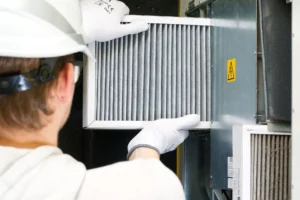
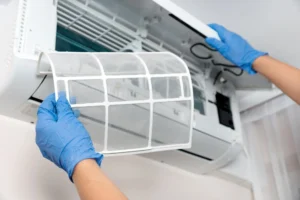
A dirty air filter causes leaks indirectly by starving the coil into freezing. Restricted airflow drops the coil temperature below freezing, ice forms, and the thaw becomes cause number two. The filter is also the one leak cause you can eliminate this afternoon.
Check yourself first:
hold the filter to a light, and replace it if light does not pass through. In Florida's long cooling season, that check is worth running monthly. The filter chain ends in ice, water, and a coil working against itself.
Disconnected Drain Fitting
A disconnected drain fitting leaks clean water at a joint. Drain lines are PVC, joints work loose with vibration, and a fitting that was hand-tightened at installation eventually separates. The leak appears at a pipe joint rather than under the coil or pan.
Check yourself first:
follow the drain line from the air handler and look for moisture at each joint. A loose fitting you can see is worth photographing for the technician. Leave the reassembly to the visit, because a misaligned drain slope recreates the problem.
What to Do Before We Arrive
Three steps protect your home while you wait for a leak repair:
- Turn the system off if water is spreading toward walls, flooring, or furniture.
- Contain the water with towels and check the pan under the air handler.
- Note when the leak happens, because a leak only during cooling points to condensate, and that detail shortens the diagnosis.
A leak repair visit starts with the $89 diagnostic during normal business hours. The fee is typically waived on repairs over $500. Water moving through a ceiling is worth an emergency AC repair call at any hour. Drywall damage grows by the hour while a drain repair takes less than one. Homeowners on our maintenance membership avoid most leaks entirely. Scheduled visits keep trained eyes on the drain system all year: HVAC Maintenance Membership: Plans From $99/Year.
Need AC Repair in St. Petersburg, FL?
Fast and reliable service from local experts.
Schedule your service today!

Keeping Pinellas County
Cool Since 1983